Tuesday, 22 November 2011

Tuesday 22 November

We have had the pleasure of a rare dry day today, giving us a chance to see what's out and about instead of hiding inside hoods and waterproofs!
Beinn Dearg in the November sunshine

Out on the hills it looks like winter. I saw some viviparous fescue (Festuca vivipara) grass which is well adapted to poor weather and short seasons. Viviparous means giving birth to live young, not something you would usually associate with grass. What the grass actually does is to produce lots of little grass plants instead of seeds. These are ready to grow as soon as they fall off and bed into the ground. Genetically they are the same as the parent plant, but on the hills soemtimes the season is too short or inclement to have time for all the pollination and seed production. Sheeps fescue and red fescue grasses also grow on the hills, but they produce seeds normally.
Viviparous fescue - there are lots of little 'grasslets' at the end of each stem.

Roe deer are becoming a common sight again in the woods around the Castle. Now that most of the human and canine visitors have gone home, the woods are quiet, and the deer usually spend the winter here before disappearing again in the spring

Saturday, 5 November 2011

Saturday 5th November


The winter weather is starting to kick in and the mornings are becoming frosty. There is a fog settled over the River Gary and Tummel every morning which looks quite nice and strange when the rest of the landscape is really clear. It is becoming that time of year where you will have to spend some extra time in the morning defrosting your car and allowing more time to travel to take account of the ice on the roads.

Today we will be doing one of our monthly nature club events which will be all about pine martens and what better way to start the day than spotting a pine marten whilst out walking the dog. The ranger was just in the right place at the right time to spot the pine marten and it was great to see. Pine martens are about the size of a small cat and live mainly in wooded areas. They are the only mustelid to have semi retractable claws allowing them to climb trees and live in hallowed out trees, squirrel dreys and can even be found living in bird nests. Pine martens tend to be active at night and at dusk so are seldom seen during the day. They are opportunistic feeders and will eat a wide variety of food including small mammals, squirrels, birds and bird eggs, fish, insects, frogs and even carrion. A grey heron and a roe deer was also spotted whilst out for a walk so it was a good morning for wildlife spotting.


Pine marten at the Highland Wildlife park
Whilst in the visitor centre yesterday, which is now closed to the public for the winter, I came across something surprising. A wren was circling around the visitor centre trying to find a way to get back outside. It must have flown in the day before without anyone noticing then could not find a way back outside. After a bit of perseverance I managed to get the little bird back outside but it was understandably panicked by the ordeal and landed in the grass. I placed in a shaded tree out of reach of predators and passing dogs so it would have peace to calm down before it was able to fly properly again and start hunting for food. You never know what you are going to come across when you are out and about so keep your eyes and ears open, you could come across something really interesting. 
Wren from the ranger information centre
As it is Guy Fawkes night I thought I would take this opportunity to remind you to check your bonfires before you light them as hedgehogs or other wildlife may be using them as a place to start hibernating. Please also be aware of where you place your bonfire i.e. not too close to roosting sights or bird boxes as boxes will still be used for shelter during the winter. Please be safe, sensible and enjoy bonfire night.

Wednesday, 26 October 2011

Wednesday 26 October

Lost dog found!


Daz appeared today after being lost in the hills since Friday 21st. He was last seen on Carn a Chalamain, and his owners and frineds have been looking for him ever since, but with no sign until today. He was first spotted near Marble Lodge and then sightings were made down Glen Tilt to the village. He was finally picked up at Blair Castle Caravan Park. His owners were most relieved to get him back, a little thinner and tired, but otherwise ok.

Many dogs get lost in the hills in this area by chasing mountain hares. These hares will keep running for miles, they don't have burrows to disappear into. Usually the dog gives up after some time, but by then they are disorientated and a long way from their owners. So keep your dog under close control or on a lead, especially if it likes to chase. Dogs rarely catch hares, but particularly in the winter, hares can suffer from exhaustion after a chase.

Sunday, 23 October 2011

Sunday 23 October

Autumn is definitely moving along now. The larch trees here have turned golden, and the paths through the woods are now lined with a soft yellow needle carpet. It's very pretty except when you are cycling and the needles end up coating your chain, gears and brakes! Larch is the only deciduous conifer we have, losing its needles every autumn and growing new ones in the spring. This makes it a lovely tree for the landscape as you get new bright green needles in spring as well as the autumn golds.

Golden tufted needles of larch.


The history of the larch tree in Britain is intertwined with the Dukes of Atholl. The Second Duke introduced European larch to his estates, for landscaping and beauty. The Fourth Duke realised the larch's potential for boat building, as it is very resistant to rot. He had more than 15 million larch trees planted in his woods around Dunkeld. During the Seventh Duke's time just over 100 years ago, the Hybrid larch was born on Atholl Estates near what is now the Hilton Hotel. This is a hybrid between the European Larch and the Japanese larch and is disease resistant and grows straight. It is the larch that is used in forestry still today.

Wednesday, 19 October 2011

Wednesday 19th October

We recently had our Roaring Stags walk which was a great success. We saw loads of red deer and heard the stags roaring at each other and trying to hold their own harem. Unfortunately the wind was coming from behind us so the deer were able to hear and see us coming at a distance but we still got close enough to get a good look at them. If you are out in the hills or woods today take time to stop and listen, you may be lucky enough to hear the male deer roaring during the rut.   
Re deer ahead roaring
What better place to be looking at deer

View along Glen Tilt


Tuesday, 18 October 2011

Tuesday 18 October

Proper snow.
We had a dusting of snow a couple of weeks ago, but this morning Beinn a Ghlo is white from top to bottom - well we can only see the bottom, the rest is in cloud, possibly still snowing up there.
Hard to see the snow when there's so much cloud!
Snow on Ben Vrackie which wasn't in cloud!

Autumn in Logierait Woods. Looks a different place completely to the snowy mountains.

It's still very autumnal in the woods with golden leaves and lots of fungi, but winter has definitely come to the hills.

Monday, 10 October 2011

Monday 10th October

The rain over the last few days has made it great for seeing rainbows. There has been one out most days now which is always pretty to look at. Nobody ever sees the same rainbow; the rainbow you see is unique to you because it all depends on where you are standing how the light is refracted through the rain drops. It just makes them a bit more special and intriguing to look at.

Whilst out on a land rover tour we were very lucky enough to see some stags barking at each other. I say see because we couldn’t hear them because of the noise of the river. There were several lone stags barking and others trying to hold a group of females called a harem. At one point another stag came over to challenge a harem holder and they had a roaring competition. He obviously lost because the next moment he was gone and no battle ensued. This is a great time of year for hearing them and seeing them, as long as you don’t try and get too close as they can be dangerous during the rutting season.

We also saw several peregrines perched on the line or flying around and spotted some red squirrels up at Gilberst bridge and forest lodge. The red squirrels can be found right up into the glens even though there is not much woodland cover further up.

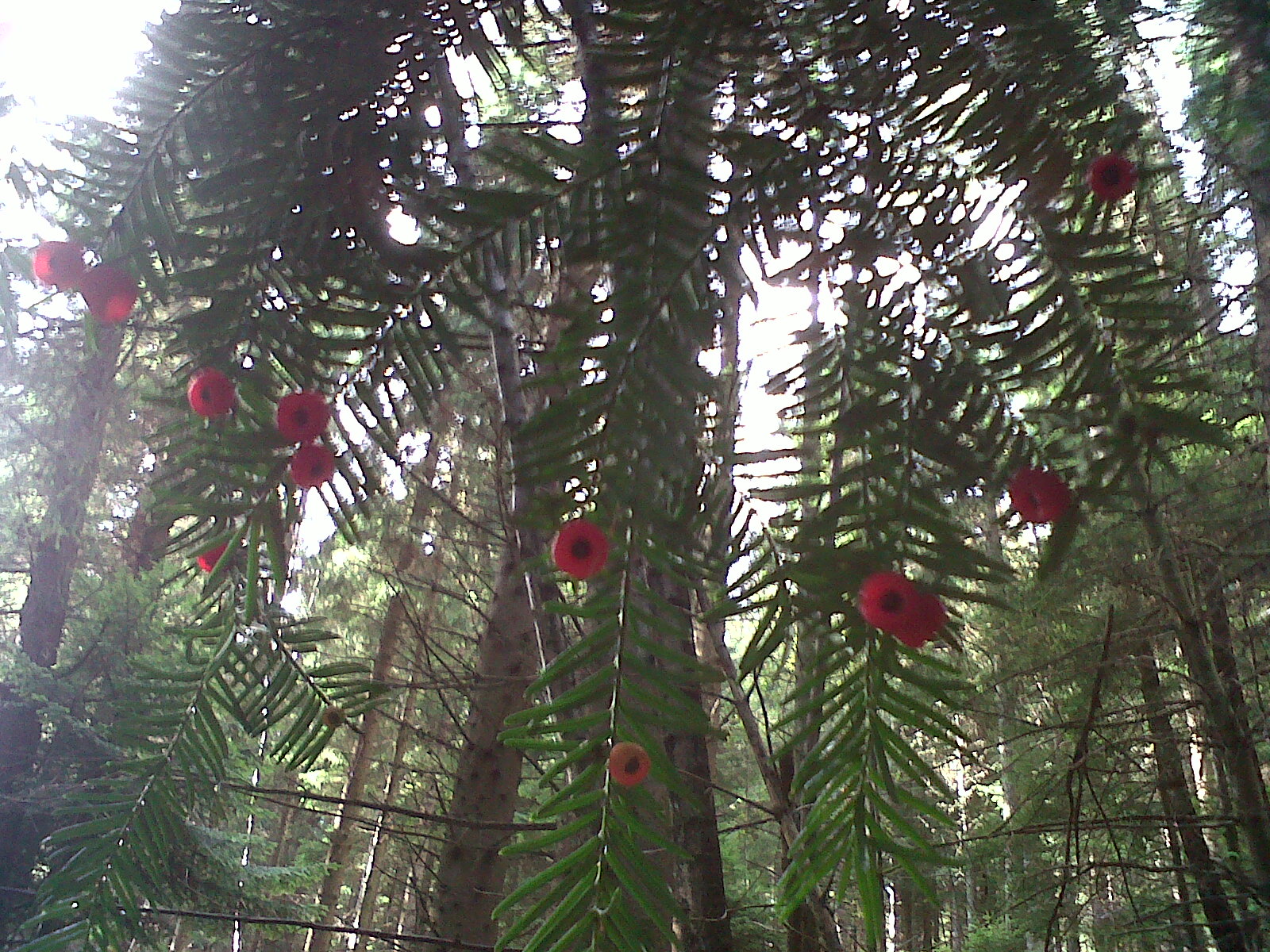
The ‘yew berries’ are out now which will be making a good feast for birds and badgers. It is not actually a berry per say but is a seed covered by a sweet, mucilaginous appendage called an aril. The seed itself is full of toxic alkaloids which make it very poisonous but birds and badgers are able to eat it because the seed passes through their body intact. They can then disperse the seeds in their faeces and allow the yew tree to establish elsewhere.