Saturday, 2 June 2012

Osprey Antics

It was a whole month ago now that we took the Blair Atholl Nature Club on an outing to the Loch of the Lowes Wildlife Reserve, run by the Scottish Wildlife Trust. That we're only telling you about it now just goes to show what a busy month this has been!

It was a great day out for everyone. We learned about the wildlife that lives on the reserve and lots of interesting things about the reserves star attractions, a pair of breeding Ospreys. Everyone's favorite part of the whole trip was building a life-size model of an Osprey nest. Appreciating all the effort that goes into building a nest roughly the size of a double bed really makes you appreciate the lengths these birds go to and the strength they posess.

Inside the osprey nest holding two replica osprey eggs

Many thanks to the Scottish Wildlife Trust Ranger for organising and entertaining the Nature Club! It's

Sunday, 20 May 2012

Bark Britain

We ran our Bark Britain sponsored dog walk today. We couldn't ask for better weather, lovely and sunny, but not too hot for the dogs. Thanks to everyone who took part, we raised more than £500 for Macmillan Cancer and Medical Detection Dogs today. Special congratulations to Cara, a border collie with only 3 legs, who still managed to complete the 10 mile route.

Look carefully - I've only got 3 legs!

Friday, 18 May 2012

Black Grouse Count

Last weekend we finished off our black grouse surveying for this season. Black grouse (Tetrao terix) are an upland species, usually found somewhere between 250 to 500 meters altitude on heath and farmland, usually near trees or other forestry which they use for shelter. The males display to compete for the attention of females and gather together on areas of open ground to show off their prowess. The site where the grouse congregate and display is known as a 'lek.' Females also gather at these leks and will select the top male to mate with.
Two Black grouse males lekking on Atholl Estates.
Photo: C. Gilhooley
Although black grouse are not considered to be threatened as a species, numbers of black grouse have declined in the UK and the bird is now completely gone from many of the sites where it would have formerly lived. The decline of the species in the UK is largely due to habitat loss and disturbance as well as predation from foxes and crows, etc. Perthshire and the Cairngorms National Park however remains a stronghold for the black grouse and the numbers are thought to have been increasing in recent years.

The surveying that we carried out meant that we had to be up to observe the lek sites and count the number of males in attendance in the very early morning, at around dawn. The highest number of grouse that we counted at an individual lek site was 30 but leks of 8 to 12 were also common. In Russia, gatherings of 150 are not uncommon - this must be a very noisy congregation as the loud, bubbling call of the male  can carry for up to a kilometer and appear very noisy in the quiet of the early morning. During the display the cock (male bird) crouches down and fans his lyre-shaped tail to display his striking white under-tail feathers while partially spreading his wings and inflating his vivid red wattles (the red protuberances above the eyes).

Our count data will be collected by the Perthshire Black Grouse Study Group and when everyone involved has submitted their figures we will be able to get an accurate picture of how the population is doing this year. The reason that we won't know for sure until all the numbers are in, is because the lek sites and the sites that individuals attend can vary each year.

If you'd like to find out more about the studies of black grouse, or know of black grouse in your area and would like to get involved with counts there's plenty of information available at the Black Grouse UK website.

Thursday, 3 May 2012

Songs of Spring

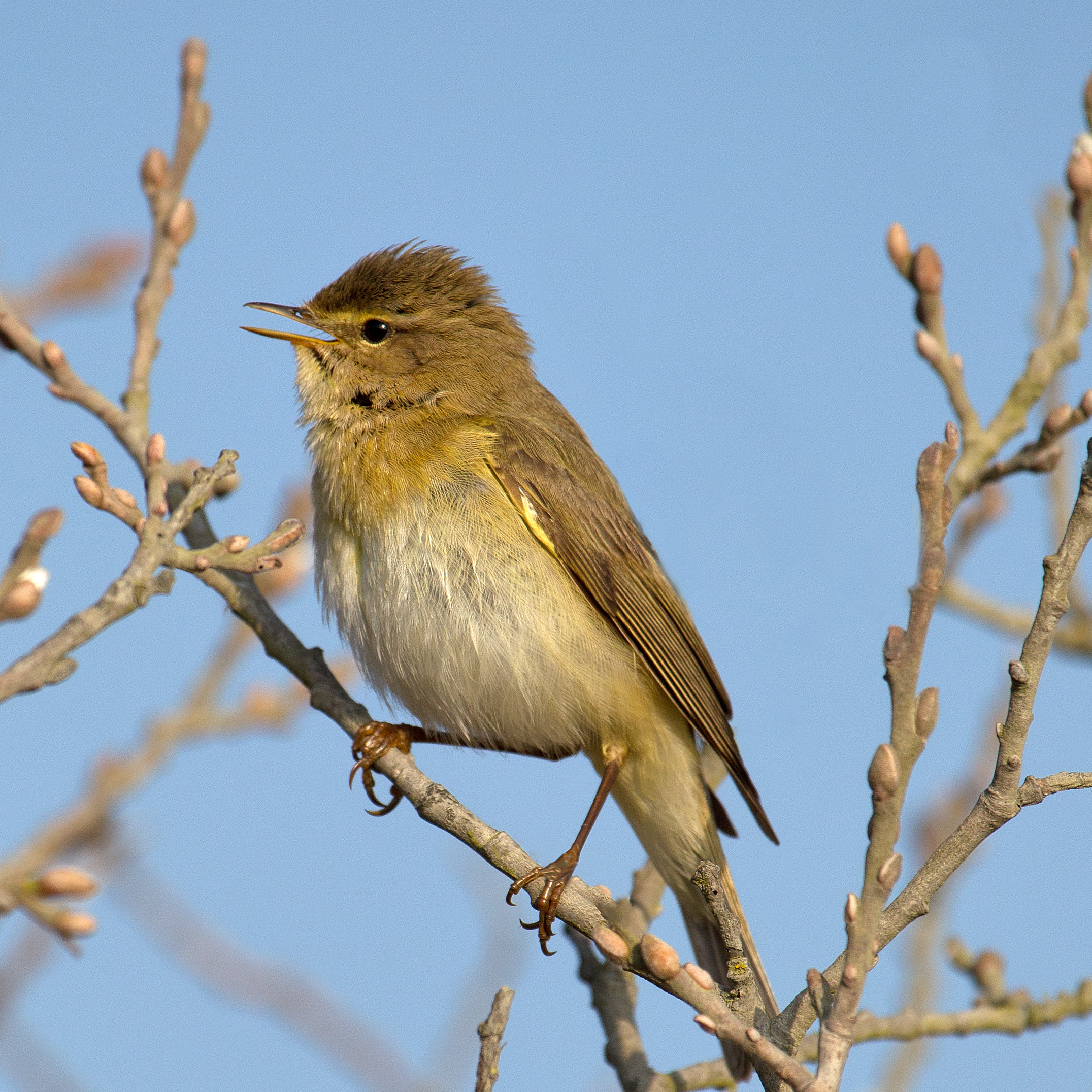
The migrant birds are fast returning from their winter homes. Last weekend willow warblers returned to Blair Atholl. Chiff chaffs have been around for a good while. These 2 birds look very similar, and their song is the easy way to distinguish them. they are both a yellowy, green, brown colour and quite hard to see, but the chiff chaff advertises his presence singing Chiff Chaff, Chiff Chaff, Chiff Chaff... endlessy. The willow warbler manages a lot more of a tune, with a lovely song that slowly descends in tone.

Spot the difference, the chiffchaff is the one on the right!
photo credit: Hans Hillewaert

We are eagerly awaiting the first swallows. They have already been back in Pitlochry for quite a few days so they should be here any day.

The good weather earlier in the spring has also meant that a lot of birds got a good headstart breeding and we have already seen a lot of birds' eggshells on the ground. Hopefully a sign of hatching rather than predation.

Wednesday, 25 April 2012

Really Wild Cats?

Yesterday was the closing conference for the Cairngorm Wildcat project. After four years of intensive study and working with landowners to champion the plight of the Highland Tiger, the project is coming to an end. But that won't be the end of the work aimed at saving the wildcat from extinction in Scotland. There was a real sense of positivity at the conference. A feeling that the close of this project  was really the beginning of a new phase, one where something might really start to be achieved, building on the knowledge, experience and relationships that the project has helped to develop.

Wildcat - the highland tiger sneaks through a hole in the fence
There were many interesting things discussed but one of the most immediately startling was the reminder that one of the greatest threats to the 400 or so 'true' wildcats still in the wild remains the threat from hybrid and domestic cats. A staggering 90% of the wild-living cats that inhabit the Cairngorms National park are thought to be either domestic or hybrid cats, only the remaining 10% are 'true' wildcats.' These feral and hybrid cats are a threat to the wildcat because they compete for the same resources (food, habitat, den sites, etc.) as well as transmitting diseases but they can also compete for mates meaning that there can be a reduction in the 'wild lineage' if the 'true' Scottish Wildcats are prevented from breeding with each other. As there are about 17,000 people living in and around the National Park and 1 in 6 of us own a cat, responsible cat ownership is perhaps more relevant than ever before. Have a look at the pictures of the wildcat (above) and hybrid (below) and see if you can tell the difference.

Hybrid cat - the white 'socks' are a dead giveaway.  
So the hopeful outlook of the conference will, with luck and more than a little hard graft, translate into an optimistic outlook for the wildcat. Certainly, there is a lot of goodwill for the Scotland's last wild feline. Now we have to turn its recovery into reality.

Sunday, 22 April 2012

Earth Day

Today is Earth Day. It started in 1970 in the USA and has steadily gained force, becoming a worldwide event during the '90s though it's still not that well recognised in the UK. The idea behind the day is an attempt to "Mobilize the Earth" into doing more to celebrate and benefit the environment - if we all take one day where we think about how our actions are affecting the Earth, maybe it will be in our consciousness more often.

Here's a thought provoking Earth Day video from the US Environmental Protection Agency that has a message equally relevant for over here:


The littering issue isn't too bad here on Atholl Estaes as we're happy to see that most of our visitors seem to respect the landscape and take their rubbish away with them. That said, we do have to deal with the occasional trouble hot-spot and keep on top of things in the busier areas. But thank you to everyone who does their best to take their litter away and keep Scotland clean for everyone!

Friday, 13 April 2012

Logierait Woods is teeming with primroses at the moment. Every sheltered bit of bank seems to have some yellow flowers growing on it. Primroses are one of the first of our flowers to be seen in the spring - its name comes from 'prima rosa' - the first flower. They flower early to take advantage of the lack of competition for the sunlight, before other plants grow up around them. They need damp conditions so are usually found in woodland and banks tucked out of the direct sunlight.


Primroses appear to be declining in East Anglia, proabably because the climate has become somewhat warmer and drier, and it simply isn't damp enough for them anymore. This is not a problem that we are having in Scotland!

Primroses are one of the species that Plantlife are monitoring to look at changes in British wild flower populations. If you would like to help them by counting primroses in your area, find out more from: http://www.plantlife.org.uk/things_to_do/wildflowers_count/