Friday, 31 August 2012

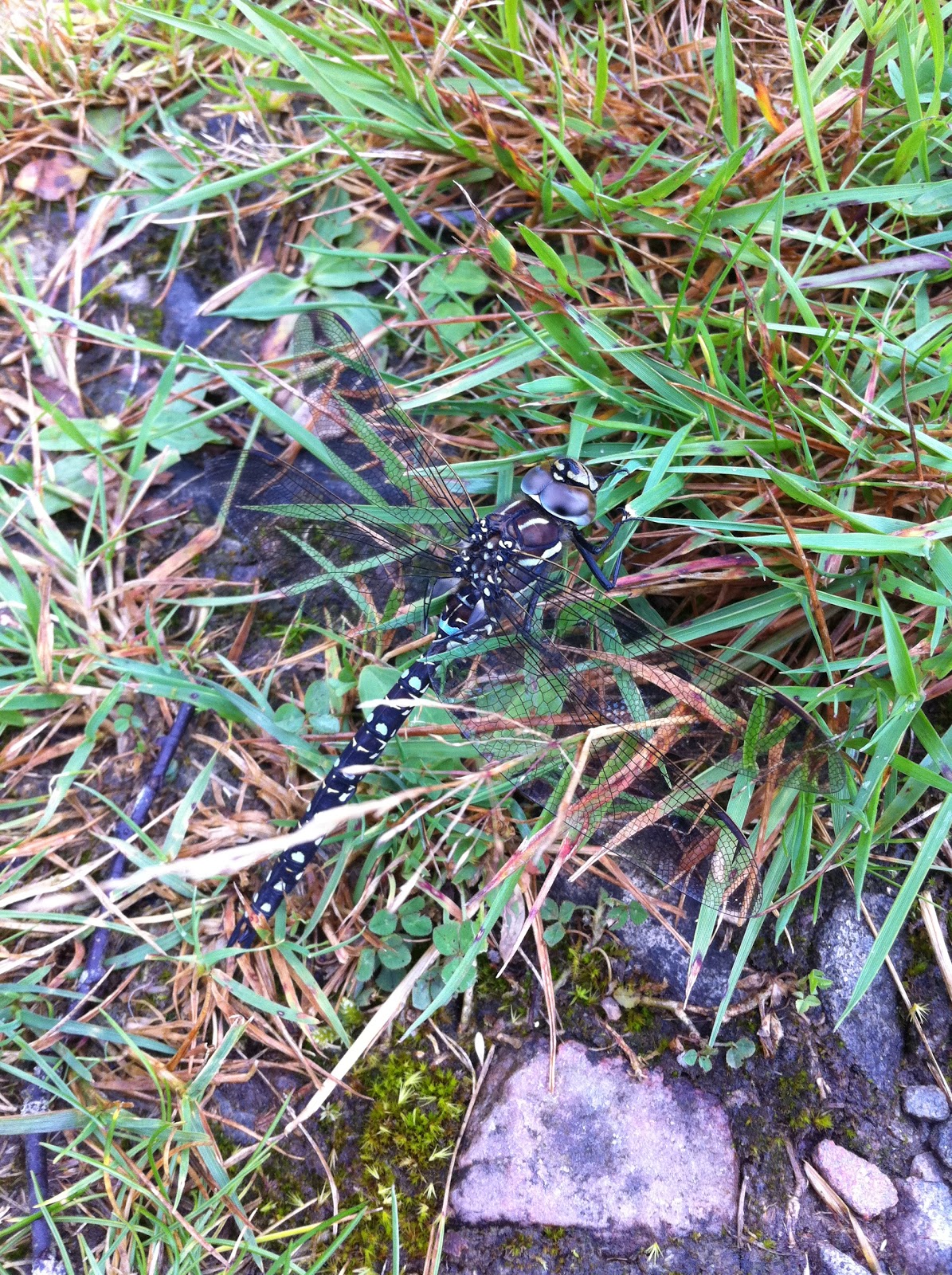
Dragonfly Sightings needed

If you are lucky enough to be out on the estate on a sunny day, then keep an eye out for dragonflies and damselflies. The rarity of sunshine this summer has made them tricky to spot. Dragonflies are wonderful to watch, but are mostly quite easy to identify too, as there are not too many species in Scotland, though beware, the blue damselflies can be tricky!

Common hawker seen near the River Tilt.
It's large, black, blue and green and a very strong flier.

Black darter seen at Polney Loch
- Our smallest dragonfly, it emerges late so commonly seen in August / September


The British Dragonfly Society are producing a new dragonfly atlas for Britain. A new atlas is needed because climate change is affecting the range and emergence time of different dragonflies and some new species for Britain have also been recently recorded. Sightings in this area are generally low, so distribution data is quite poor. For more information on the areas most in need of new records visit http://british-dragonflies.org.uk/content/national-dragonfly-atlas . If you are confident in your identification, then send your sighting to the BDS - this is the last year to submit sightings before the production of the atlas next year. http://british-dragonflies.org.uk/content/submit-records

If you get very keen you can go pond dipping to get the nymphs too. This doesn't need the sunshine and can get quite addictive (and quite muddy!). All dragonflies spend far more time as nymphs in the water than they do as adults. The nymphs can be identified to species level as well but it is tricky compared to the adults.

Saturday, 18 August 2012

Junior Rangers

The Cairngorms National Park rangers run Junior Ranger groups for teenagers who want to help out with wildlife and conservation. Last week a group from the Bayerwischer Wald National Park in Germany joined some of our Scottish Junior Rangers for a week of fun and helping out in the northern Cairngorms. We helped out with the group on their final day.


Many of the Scottish youngsters went to the Bayerischer Wald last year for a visit. This year other Cairngorms Junior Rangers have been on a visit to Slovenia for a week.

We hope to set a Junior Ranger group for interested teenagers in Highland Perthshire soon.

Monday, 6 August 2012

Stalking Season - Hillphones & Heading for the Scottish Hills

The red deer stag season is open from 01.08.2012 until the 20.10.2012. To help hill walkers and other outdoor recreational users plan their visit and practice responsible access to the Scottish countryside, we will once again be providing information about where and when stalking is taking place.

The information provided by Atholl Estate Ranger Service covers the Atholl and Lude Estates, incorporating the Munros of Beinn Dearg, Carn a' Chlamain, Beinn A' Ghlo and the south sides of An Sgarsoch and Carn Ealar as well as the Corbetts Ben Mheadhonach and Ben Vuirich.


Details are available online from the Heading for the Scottish Hills website where you can find up to date information about the deer stalking taking place on all of the areas that are involved in the pilot scheme, now entering its third year. There is also a Hillphones service available on 01796 481 740 where you will find a recorded voice message detailing the areas where deer stalking will be taking place. 

Lastly, information is also available from notice boards at the Glen Tilt Car Park and inside the newly refurbished Blair Atholl Information Centre & Ranger Base in Blair Atholl.  Using these services should enable you to plan your visit to avoid routes that may disturb deer stalking whilst still fulfilling your goals.  .

Screenshot of the Heading for the Scottish Hills website

We appreciate that most people like to plan their visits in advance and will always endeavor to have as much information available as possible, it is often not possible for to determine where stalking will take place until a few days or the morning beforehand. Generally, longer range information will be made available on the website as we obtain it but please re-check this information through one of the information facilities closer to the time of your visit as changes may often be made.


Atholl Estates Ranger Service


Saturday, 4 August 2012

My National Park Adventure Writing Competition


To help celebrate National Parks Week, 15 members of the UK's National Parks family and brand partner Merrell, outdoor gear specialist, are teaming up to launch the My National Park Adventure competition for young people. Would-be travel bloggers are being urged to write a piece of 500 words or less about their National Park adventures this summer.

Remember that adventure is what you make it! We want to see young people making the most of their National Parks - so check out the range of National Park events on our website and tell them about your adventures!


Aspiring litterateurs (that's a posh word for 'writer' – we had to look it up) can enter the competition via the UK National Parks website: www.nationalparks.gov.uk/mynationalparkadventure

Entrants will need the permission of a parent or legal guardian.

There are two categories for entries: Authors of 11 years old and under / Authors aged 12-16 years old (inclusive). 

One winner will be chosen from each category, and he or she will walk away with brand new top-quality footwear provided by Merrell. So, get writing!

Stories must be submitted by 12 noon Friday, 7 September 2012, and must take place in one of the 15 Members of the UK National Park Family: Brecon Beacons, the Broads, Cairngorms, Dartmoor, Exmoor, Lake District, Loch Lomond & the Trossachs, New Forest, Northumberland, North York Moors, Peak District, Pembrokeshire Coast, Snowdonia, South Downs and Yorkshire Dales.

Full details of the competition, as well as terms and conditions, can be found at: www.nationalparks.gov.uk/mynationalparkadventure

Wednesday, 1 August 2012

Scouts' Jambourette 2012

The last two weeks have been a busy and bustling time for us. There have been about 2000 Scouts and Scout leaders staying in the Castle grounds for their biennial Jamborette and we got lots of them out and about, helping us with some tasks a bit too big for us to tackle on our own!
View of the Bair Castle and the Scout Camp

The Scouts did a great job of installing a new bike rack in the Glen Tilt car park - so now  there's somewhere to securely lock your bike up if you cycle up for a picnic or a stroll.

They also refurbished one of the flights of steps along the riverbanks trail, beside the caravan park.

We took several groups up Glen Tilt to thin out a stand of birch trees that has been becoming too thickly overgrown. Their hard work will help the trees by opening up the canopy, letting in more light and allowing them to grow larger and stronger. Opening up the canopy and letting in more light will also help the plans and shrubs that make up the woodland undergrowth, making it a more diverse mosaic - and better for herbivores too!
Close up of the Camp - lots of tents!

There was plenty of hard work too from the groups that we took out to Calvine to do a bit of repair work to a section of the historical, "Wade's Road," an old military route that was built to improve the access for British troops to the Highlands. Large sections of the track had been becoming waterlogged because of inadequate drainage so we set to work with picks and shovels and no small amount of hard graft to put in cross drains and drainage ditches. The result was a noticeable difference to the state of the track after much of the running water had been diverted away.

Deciding where to put a cross-drain to drain standing water from Wade's Road

All of the Scouts that we had out with us on tasks were brilliant this year, they worked really hard and were a credit to their leaders and their home troops. It was also quite exciting for us to meet some scouts from pretty far-flung places such as Norway, Canada, Japan and Russia. The "Austrian" scouts from Aberdeen were also very entertaining (and convincing!).

See you again in two years time!

Wednesday, 18 July 2012

New Ranger Events Page

You can now access the ranger events from the blog. Just click on the "Ranger Events 2012" tab under the title bar at the top of the page and then follow the link to the PDF file.

Tuesday, 10 July 2012

Bumbling along or toiling away?

Bumblebees  are associated with warm weather and long sunny days. Even if it hasn't been as warm as we might like, now that we're in the midst of what is passing for summer there should be plenty of bumblebees about for you to discover in your gardens or when out for a walk in the countryside.

Bumblebees feed on and collect the nectar from flowers and take it back to their hives where is is used to feed their young or stored. Bumblebees are much more open to food shortage than honeybees however, as they only store a few days worth of nectar at a time.Because they visit many different flower species, bumblebees are hugely important to our ecosystems as pollinators. As well as helping wildflowers to reproduce it has been estimated that the pollination 'services' of bumblebees are worth something like £400 million each year to the UK agricultural economy. So it would seem that visiting flowers all day is pretty hard work!


Heath Bumblebee (Bombus jonellus) feeding on a thistle flower


Of the 24 species of UK bumblebee only 8 are commonly found throughout the UK, in almost all habitats where there are flowering plants.. The rest are much less common or even very rare; the Great yellow bumblebee (Bombus distinguendus) is only found in a few places along the north coast of Scotland. Numbers of bumblebees have declines severely throughout the UK since the mid 1940's and two species have actually become extinct in the UK. The decline of the bumblebee is largely due to changing agricultural practices such as increasing field sizes and intensive planting of single crop species (monoculture). This has led to a 97% reduction in flower-rich grasslands from 1930's levels and removed large portions of bumblebees' preferred habitat.

Recently the Bumblebee Conservation Trust teamed up with the RSPB and other partners to reintroduce the Short-haired bumblebee (Bombus subterraneus) at the RSPB's Dungeness reserve on the south coast of england. It is hoped that by working closely with local farmers and other landowners to help provide plenty of suitable, flower-species rich habitat in marginal agricultural land, the reintroduction of the bee will be a success.

If you'd like to find out more about bumblebees and how to identify them you can visit the Bumblebee Conservation Trust's website. There you will also find information and links to surveys that members of the public can get involved with, such as "BeeWatch" - an ambitious project that allows you to upload your photos of bumblebees and get help to identify them. This has already helped to discover new populations of bumblebees. The more people that are involved the more information the project will be able to gather!

Closer to home you can also help by planting "bee friendly" flowers in your garden so that you are helping to provide a variety of plants suitable for different species of bumblebee. Other simple ways to help could involve making an overwintering shelter or "bee house" for bees to take refuge in and hibernate over the cold winter months. This BBC Breathing Spaces webpage has some really good ideas to get you started thinking about homes for different bee species and there's a link to a make for a really good one for bumblebee's at the bottom of the page!