Wednesday, 26 June 2013

Wild Scotland: spaces for nature

A brilliant short video produced by 2020 Vision that we came across and couldn't resist sharing with you. The video encourages and explores the idea that nature needs our help and we need it. The video gives a special mention to several places and projects going on across Scotland and in the Cairngorms National Park too. Make your own wee space for nature - sit back, relax and enjoy it!

Wild Scotland from 2020VISION on Vimeo.

Thanks to @CameronMcNeish for sharing!

Monday, 24 June 2013

New Atholl Walking Trails

The ranger service has been hard at work installing new set of waymarked trails around Blair Atholl and the surrounding area. The way markers are now all in place for visitors and locals alike to explore the trails but the work wouldn't have been possible without the hard work of volunteers and input from the Cairngorms National Park Authority and local Tourism Association.


Three of the trails start from the Blair Atholl Information Centre, located on the main road beside the River Tilt, and two more begin from Struan, to the north. A sixth trail uses the existing trails around the Falls of Bruar, starting from the House of Bruar.

Copies of the accompanying Atholl Trails booklet, guiding you around the walks, are available in the Blair Atholl Information CentreYou can view a printable version of the Atholl Trails booklet, guiding you around the new walks printed copies are available in the Blair Atholl Information Centre. You can also view a printable version of our own Waymarked Trails from Blair Atholl online.


Sunday, 23 June 2013

Waymarked Trails on Atholl Estates

Click on the pictures of the trails booklets below to view printable online versions of the publications.

Waymarked Trails from Blair Atholl (published by Atholl Estates)
http://goo.gl/iUIJB

Atholl Trails (published by the Cairngorms National Park Authority)
http://goo.gl/tS2sZ

Countryside Trails Dunkeld (published by Atholl Estates):
http://goo.gl/x2a5v


Cycle Routes from Blair Atholl
(published by Atholl Estates)

This booklet is not currently available as an online document but several 
downloadable route cards are available by following the links below:


Saturday, 22 June 2013

A Day for Dwarf Shrubs

The rhododendron is in full flower in the Castle grounds and looking quite magnificent. However, the common rhododendron (Rhododendron ponticum) is not always so welcome out in the wider countryside where it can spread through woodland swamping other vegeatation completely until there is nothing left but the rhododendron. It looks good at this time of the year, but it's not a good wildlife habitat at all.


But there are other native shrubs that are flowering just now. They are a lot smaller than rhododendron, but they don't take over, and provide much more for our birds and animals.

Here are the flowers of cowberry, an evergreen shrub of woodland and moorland, and blaeberry (or bilberry in England), which is deciduous. Both of these flowers will eventually turn to fruit. We know and love the blaeberry, but so do many other creatures - lots of birds and some mammals including pine martens and badgers. The cowberry has a red berry which is not so tasty to us (though not poisonous), but still important for other creatures.

Round ball-shaped flowers of the blaeberry
 In addition the bushes provide food for many insects, which then provide food for birds, especially chicks which need protein to develop. The capercaillie feeds its chicks on caterpillars from blaeberry bushes
These shrubs also provide great shelter, particularly for ground-nesting birds.

Bell-shaped flowers of the cowberry


Friday, 7 June 2013

Bambi and Other Babies


Spring has definitely arrived at last and the grounds of Blair Castle are teeming with new life. An oystercatcher has laid eggs in the car park (don't worry, we've roped it off so they don't get squashed!) and another oystercatcher has chicks running aound near hercules Garden. The resident swans in the garden are also busy on their nest, and are pretty unwelcoming if you get too close.

You need to look carefully! Not the best shot but after this it went inside the tree fence and was even harder to see!
 
Two red deer calves have also just been born in the deer park. They look gorgeous with their spotty coats which are for camouflage. The mother also cleans their rear end assiduously so that they don't give off any scent to attract predators when they are left alone on the hill. She leaves her calf while she feeds and returns to it later .Calves usually appear earlier in the park than in the wild because the deer here have an easier life and are better fed. Wild calves are usually born in June though it may be a little later this year. If you visit and notice that the magnificent stag is missing, don't worry. He has gone to a new home and will be replaced with a different stag so that there is some fresh blood / genes - we don't want the deer to get too in-bred.

Saturday, 11 May 2013

First Cuckoo of Spring

A pleasant surprise this morning. While working in Blair Castle grounds we heard the first cuckoo of this spring. It's always lovely to hear the call of the cuckoo as it's a sign that the warmer weather is on the way.

Listening to the characteristic sound also brings a sense of awe, to think that this bird -about the same size as a pigeon- has flown all the way here to Scotland from central Africa. The call is the male bird, letting females in the area know that he has arrived and is ready to take a mate.

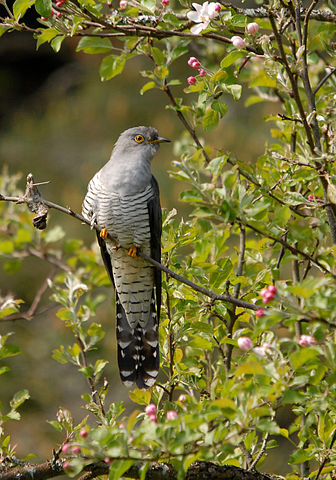
European Common Cuckoo (Cuculus canorus)
Image: Locoguapa

Cuckoos are brood parasites, a term that means rather than rearing their own chicks they lay an egg in the unattended nest of another bird, pushing out one of that birds own eggs in the process. The bird whose nest it is then unwittingly raises the cuckoo chick as it's own, unaware of the swap. The young cuckoo usually pushes it's foster brothers and sisters out of the nest, meaning it is the sole recipient of it's surrogate parents attentions. Cuckoos in Scotland usually lay their eggs in the nests of birds such as Meadow Pipits, Dunnocks, and Reed Warblers. The health of the population of Scottish and British cuckoo populations is therefore closely linked to those of these birds. The dramatic decline of cuckoos in recent years has largely been due to a reduction in their egg-hosts' populations decreasing, caused mainly by habitat loss and fragmentation.

The cuckoo has a breast patterning that mimics the coloration of the peregrine falcon and keeps potential competitors and predators at bay. This is the grey and white banding that you can see clearly in the picture above. It is though that this patterning also helps them to successfully parasitise the nests of other birds, fooling them into thinking that they are going to be attacked and eaten, and so they flee the nest leaving the female cuckoo free to lay her egg. Something which she can do in under 10 seconds!


Wednesday, 8 May 2013

Black Grouse Lekking

Dawn was a bit hazy and dull this morning but it looks like today may be nice again. Until the rain arrives, at least. I was up early to survey some Black Grouse lek sites for the Perthshire study group and managed to get some camera-phone footage of  the activity. The quality isn't amazing but you can see how easy it is to do a bit of amateur 'digiscoping' without needing too much technical kit. The initial results are below - no sound though: the grouse were a bit too far away to pick anything up!


When I get a chance I will try and get some more footage and photos up. If you'd like to get closer or have a try yourself, why not check out Atholl Estates' Black Grouse Land Rover Tours that will take you out to the action.